India's manufacturing output grew 4.26% in FY 2024-25, a substantial jump from 1.4% the year before. Global manufacturers are moving sourcing closer to India, smartphone exports alone surged 55% to reach $24.1 billion in 2024-25. The opportunity is real and accelerating.
Source: India Briefing | Outlook Business
But growth also exposes cracks. The same manufacturers benefiting from new export orders and domestic demand are often fighting older, persistent problems inside their own operations: parts that run out unexpectedly, vendors who miss delivery windows without warning, procurement teams stuck in approval chains, and planning teams working off data that's already stale by the time it reaches them.
Supply disruption, high logistics costs, inventory imbalance, and information-sharing gaps are challenges that still affect Indian manufacturing firms, negatively impacting their operational and financial performance to varying degrees.
Source: Jmsr-online
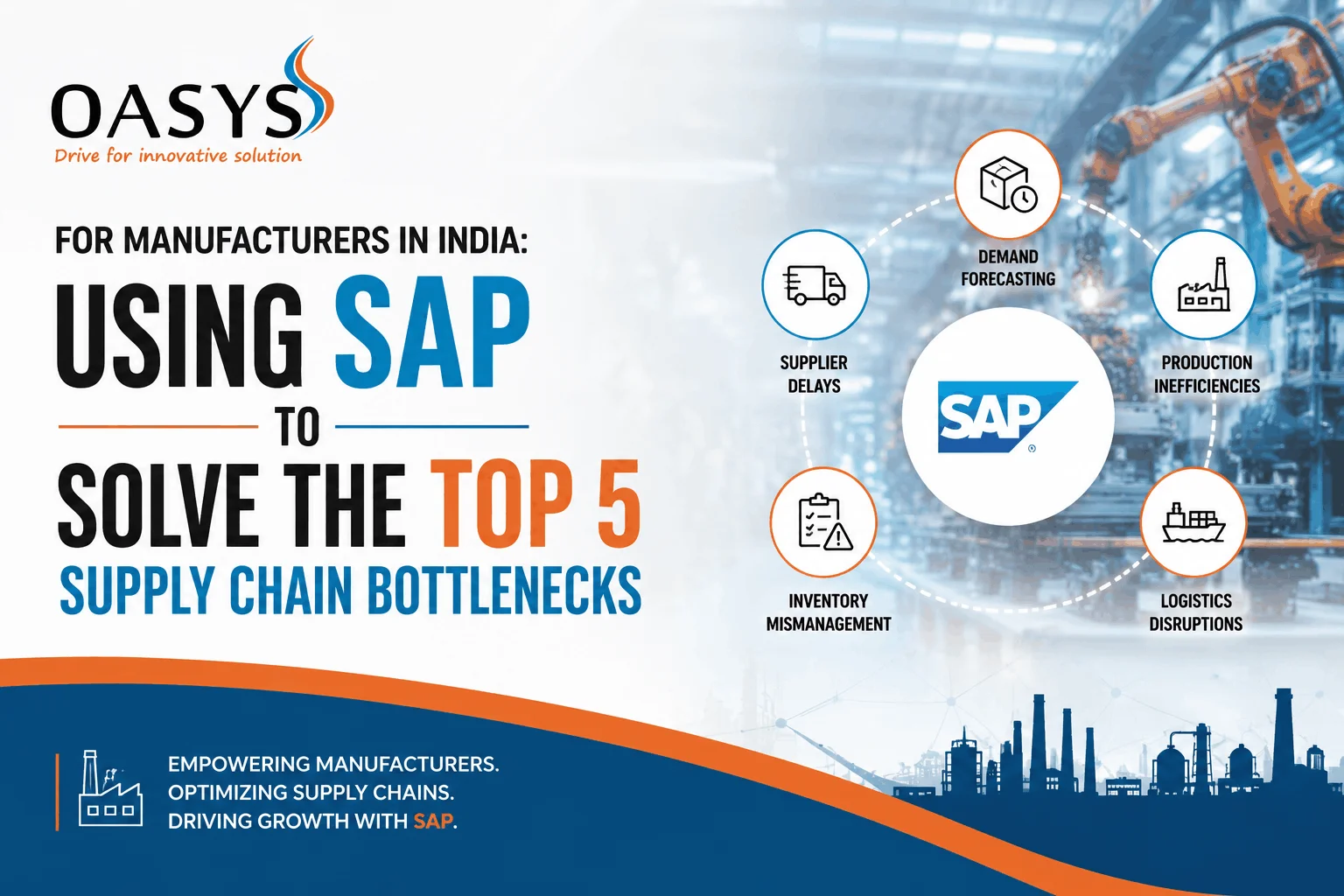
SAP, specifically SAP S/4HANA and its supply chain suite, is designed to address exactly these kinds of structural problems. This article breaks down the five most common supply chain bottlenecks Indian manufacturers face and explains concretely how SAP handles each one.
Why Indian Manufacturers Keep Running Into the Same Supply Chain Walls
Before jumping into solutions, it's worth being honest about what makes India's supply chain environment particularly difficult.
India's supply chain market is challenged by a fragmented vendor base, with around 60% of suppliers operating at a small or unorganized scale, leading to inconsistencies across the supply chain. Add to that a persistent shortage of skilled supply chain professionals: the logistics and SCM sector faces an estimated gap of 1.2 million professionals in critical roles, affecting areas like inventory management, demand forecasting, and supply chain analytics.
Source: Ken Research
Infrastructure is improving, but gaps remain. Despite significant investments in logistics infrastructure, India still faces critical shortcomings including poor road quality, limited rail connectivity, and congested ports, which delay movement and inflate logistics costs. Everfastfreight
And while a new DPIIT-NCAER study places India's logistics cost at 7.97% of GDP for 2023-24, totaling approximately $268 billion, even at this revised figure, the structural cost pressure on manufacturers remains real, especially those competing in export markets. Fibre2Fashion
The result is a manufacturing environment where even well-run companies frequently face the same five operational bottlenecks.
Bottleneck #1: Poor Demand Forecasting and Inventory Imbalances
What's Actually Happening on the Ground
Most Indian manufacturers manage demand forecasting with a mix of spreadsheets, historical sales data, and gut instinct from the sales team. The problem is that spreadsheets don't update in real time and sales teams are an unreliable signal, since they tend to over-order to protect themselves and then under-report once targets look safe.
In volatile industries like retail and building materials, common forecasting errors include over-reliance on historical trends despite seasonality or project-driven demand shifts, ignoring regional demand divergence leading to stockouts in one region and excess in another, and delayed demand signal sharing between sales, supply planning, and logistics.
Source: Knowledge Ridge
The outcome is predictable: you're either sitting on excess inventory that ties up working capital, or you're scrambling to fulfil orders you can't stock. Inventory distortion alone costs businesses a staggering $1.77 trillion annually worldwide.
Source: Commport
Inadequate demand forecasting due to lack of technology adoption leads to inventory mismanagement and high inventory carrying costs, including costs for holding and storing unsold goods.
Source: Arthur D. Little

How SAP Addresses It
SAP S/4HANA's Integrated Business Planning (IBP) module replaces static spreadsheet-based forecasting with demand-sensing that factors in historical patterns, seasonal trends, and real-time order signals simultaneously.
SAP S/4HANA lets you integrate your entire supply chain and realize a 12% reduction in the number of days in inventory, with live inventory data and drastically reduced MRP processing times improving manufacturing cycle time by 10% while enhancing planning accuracy.
Source: Nbteamconsulting
The Material Requirements Planning (MRP) engine in SAP S/4HANA runs in real time on the HANA database, which means it doesn't take overnight batch jobs to recalculate material needs. When a large sales order comes in, the system immediately cascades the demand signal through production schedules, raw material requirements, and supplier lead times. Planners can see exceptions instantly and act before stockouts happen rather than after.
SAP S/4HANA's intelligent demand planning corrects errors, guarantees availability of goods, and significantly reduces the costs of overstocking by enabling optimization of procurement, production, and logistics cycles to avoid oversupply or stockout scenarios.
Source: Primes4
Bottleneck #2: Fragmented and Unreliable Vendor Base
What's Actually Happening on the Ground
A typical mid-size Indian manufacturer might work with 200 to 500 vendors, many of whom are small, informal operations. Vendor performance data lives in disconnected systems, emails, and WhatsApp conversations. There's no single view of which vendor is delivering on time, which has quality issues, and which is becoming a dependency risk.
Issues like delayed shipments, poor quality supplies, and cost escalation threaten the credibility and business prospects of Indian manufacturers, with supply chain disruptions leading to significant losses. Source: IEOM
When a vendor fails without warning, the typical response is reactive: phone calls, emergency sourcing, expediting fees, and production delays. There's rarely a system in place to catch the problem before it hits the shop floor.
Fragmentation directly damages demand signal visibility, as each supplier only receives pieces of information relevant to their specific part, causing the ability to see true end-to-end demand to dissolve. Source: Commport

How SAP Addresses It
SAP's Supplier Relationship Management capabilities, integrated within SAP S/4HANA and extended through SAP Ariba, give procurement teams a consolidated view of vendor performance across delivery lead time, quality rejections, price variance, and compliance.
SAP SCM offers tools for collaboration with suppliers and partners that improve transparency and reduce lead times, with real-time inventory tracking, automated scheduling, and seamless supplier communication minimizing downtime and preventing overstocking.
Source: BMAX
Practically, this means you can score vendors automatically, flag those who are slipping before they cause a production stoppage, and maintain a pre-qualified alternate vendor list that activates the moment a primary source is at risk. Purchase orders, confirmations, and delivery schedules run through the system, not through email, which creates a complete audit trail and gives both sides of the relationship the same information at the same time.
Bottleneck #3: No Real-Time Supply Chain Visibility
What's Actually Happening on the Ground
Ask most operations or supply chain heads at Indian manufacturing companies what their current inventory position is across all warehouses, and they'll either give you a number from yesterday's report or tell you to check with someone who pulls it manually. Real-time visibility is, for many manufacturers, still aspirational.
Indian supply chain companies are investing over 50 billion INR in real-time tracking and visibility solutions, indicating just how acute the demand for transparency has become. Ken Research
Without visibility, you're always operating on delayed information. A warehouse in Pune might be holding excess material while a plant in Chennai is short on the same SKU. Regional stockouts coexist with regional overstocking, and no one connects the dots because the data isn't flowing in real time.
Organizations that proactively address fragmentation, demand volatility, and regulatory complexity are better positioned to build resilient and adaptive supply chain networks. Journalofsupplychain
How SAP Addresses It
SAP S/4HANA's in-memory HANA database processes transactions and analytics simultaneously, which means inventory positions, goods movements, and shipment statuses update in real time across all locations and entities.
SAP S/4HANA provides real-time visibility into supply chain processes, enabling businesses to monitor inventory levels, track shipments, and analyse supplier performance instantly, with advanced analytics and predictive capabilities helping in making data-driven decisions and optimising demand prediction. Emixa
The Extended Warehouse Management (EWM) module extends this visibility to physical warehouse operations, from goods receipt to put-away to order picking and dispatch. SAP SCM manages inventory flow from the receiving dock to the point of goods issue, optimising labour, storage, and fulfilment costs, while providing the ability to plan, execute, and monitor the movement of goods from production to the point of sale. SAP
For manufacturers operating across multiple plants and distribution centres, this unified view eliminates the blind spots that currently cause misallocation and emergency transfers.
Bottleneck #4: Slow and Manual Procurement Processes
What's Actually Happening on the Ground
In many Indian manufacturing companies, a purchase requisition still involves a paper form or an email chain, a manager approval that might sit pending for days, a separate manual comparison of supplier quotes, and a purchase order typed into a system or printed out. The average procurement cycle from requisition to PO can stretch from one to three weeks.
Small vendor and distributor networks, where manual processes continue due to limited digital literacy, remain a significant roadblock in supply chain operations, with cultural and capability-related change management being the bigger obstacle than the technology itself. Knowledge Ridge
This slowness has a direct cost. It delays production schedules, prevents procurement from consolidating spend across departments, and makes it nearly impossible to respond quickly when a material shortage appears.
How SAP Addresses It
SAP S/4HANA's Materials Management (MM) and Sourcing and Procurement modules automate the entire purchase-to-pay cycle. Requisitions are created automatically from MRP runs, routed through configurable approval workflows, matched against contracts, and converted to purchase orders without manual intervention in routine cases.
SAP S/4HANA enables organizations to automate purchasing workflows, enable electronic approvals, and integrate with suppliers for seamless order processing, reducing cycle times and improving visibility into spend. Magnascientiapub
Three-way matching, where the system automatically compares the purchase order, goods receipt, and vendor invoice, eliminates a significant portion of manual accounts payable work and catches discrepancies before payment goes out. For procurement managers, this shifts time from administrative processing to strategic sourcing, which is where the real value sits.
SAP S/4HANA creates a 40% improvement in invoice processing productivity while reducing unnecessary capital requirements by 35% through its integrated procurement and finance capabilities. Nbteamconsulting
Bottleneck #5: Disconnected Production Planning
What's Actually Happening on the Ground
Production planning and supply chain planning often exist in parallel worlds inside a manufacturing company. The production team plans based on capacity and work orders, the procurement team plans based on purchase history, and the sales team commits delivery dates based on neither. When these functions don't talk to each other through a shared system, the result is a production floor that regularly runs short of material, faces machine idle time, or produces batches that weren't actually needed.
The increase in the implementation of digital technologies and enterprise resource planning systems has enabled companies to increase the degree of accuracy in demand forecast, inventory visibility, and coordination between supply chain partners. Jmsr-online
The disconnect also affects quality. When production planning is disconnected from quality management, batch rejections don't immediately trigger upstream replanning.
How SAP Addresses It
SAP S/4HANA connects production planning (PP), materials management (MM), sales and distribution (SD), and quality management (QM) within a single data model. A confirmed sales order immediately becomes an input to production scheduling, which feeds back into material requirements, which triggers procurement automatically for items below reorder point.
SAP S/4HANA Supply Chain Management includes a detailed scheduling board that provides a graphical interface to plan and optimize production orders and operations, taking into account various constraints such as machine capacity, material availability, and labour, and integrates with the Quality Management module to ensure quality checks are incorporated from raw material procurement to finished product delivery. ERP Research
By connecting supply chain processes and collaborating with external partners through a digital business network, companies can enable more contextualized decision-making and achieve levels of automation that were previously out of reach. SAP
This integration also extends to batch traceability, which is increasingly important for manufacturers supplying regulated industries like pharmaceuticals, food processing, and automotive.
How Organizations Are Addressing These Challenges
Manufacturing companies addressing these bottlenecks are increasingly moving away from point solutions, which means standalone inventory tools, separate vendor portals, or disconnected planning software, toward a unified ERP platform where supply chain data flows across all functions in real time.
The most effective implementations share a few common characteristics. First, they start with a clear mapping of current bottlenecks before selecting which SAP modules to prioritize. A company whose primary pain is vendor management and procurement cycle time will get faster ROI by focusing on MM and Ariba before extending into advanced IBP planning.
Second, they invest in change management alongside the technology. Cultural and capability-related change management often proves to be the bigger roadblock than the technology itself, particularly in last-mile delivery environments and among small vendor networks where adoption of digital tools is inconsistent. Training procurement teams and plant managers to use system-generated insights rather than Excel reports takes deliberate effort. Knowledge Ridge
Third, they treat the implementation as a phased initiative. Large-scale SAP S/4HANA programs that try to go live on everything simultaneously carry significant risk. Experienced SAP partners typically recommend a phased approach that delivers value in stages, starting with the highest-pain areas and building capability progressively.
For manufacturers evaluating this path, working with an experienced SAP implementation partner makes a material difference. OASYS Tech Solutions brings end-to-end SAP capabilities across ERP implementation, integration, and consulting, with a specific focus on helping manufacturing and industrial organizations in India structure their SAP programs for measurable operational outcomes rather than just technical deployment.
FAQ
What is SAP supply chain management and how does it work for manufacturers?
SAP supply chain management (SCM) is a set of integrated software modules within SAP S/4HANA that covers demand planning, inventory management, procurement, production planning, warehouse management, and logistics. For manufacturers, it works by connecting all these functions in a single system, so changes in one area, like a new sales order or a supplier delay, automatically propagate across planning, procurement, and production without manual intervention.
Is SAP S/4HANA suitable for mid-size Indian manufacturers or only for large enterprises?
SAP S/4HANA has historically been associated with large enterprises, but SAP's Cloud ERP and RISE with SAP programs have made it more accessible for mid-size manufacturers. The key is working with an implementation partner who can scope the project appropriately, since a 500-employee manufacturer does not need the same configuration as a multinational. Many Indian manufacturers in the INR 200 crore to INR 2,000 crore revenue range are now successfully running on SAP S/4HANA.
How does SAP improve demand forecasting for manufacturers?
SAP's Integrated Business Planning (IBP) module uses statistical forecasting models combined with real-time sales, inventory, and supplier data to generate demand forecasts. Unlike spreadsheet-based approaches, IBP models multiple scenarios, accounts for seasonality and promotions, and recalculates automatically when actuals deviate from plan. The result is more accurate production and procurement decisions with less manual effort.