Enterprise leaders are no longer asking whether AI belongs inside ERP systems. The real question is where it delivers measurable operational value without creating another expensive layer of complexity.
That shift matters because many organizations still operate SAP environments built around manual approvals, delayed reporting, disconnected forecasting, and reactive decision-making. The ERP system stores critical business data, but teams often struggle to convert that data into timely action.
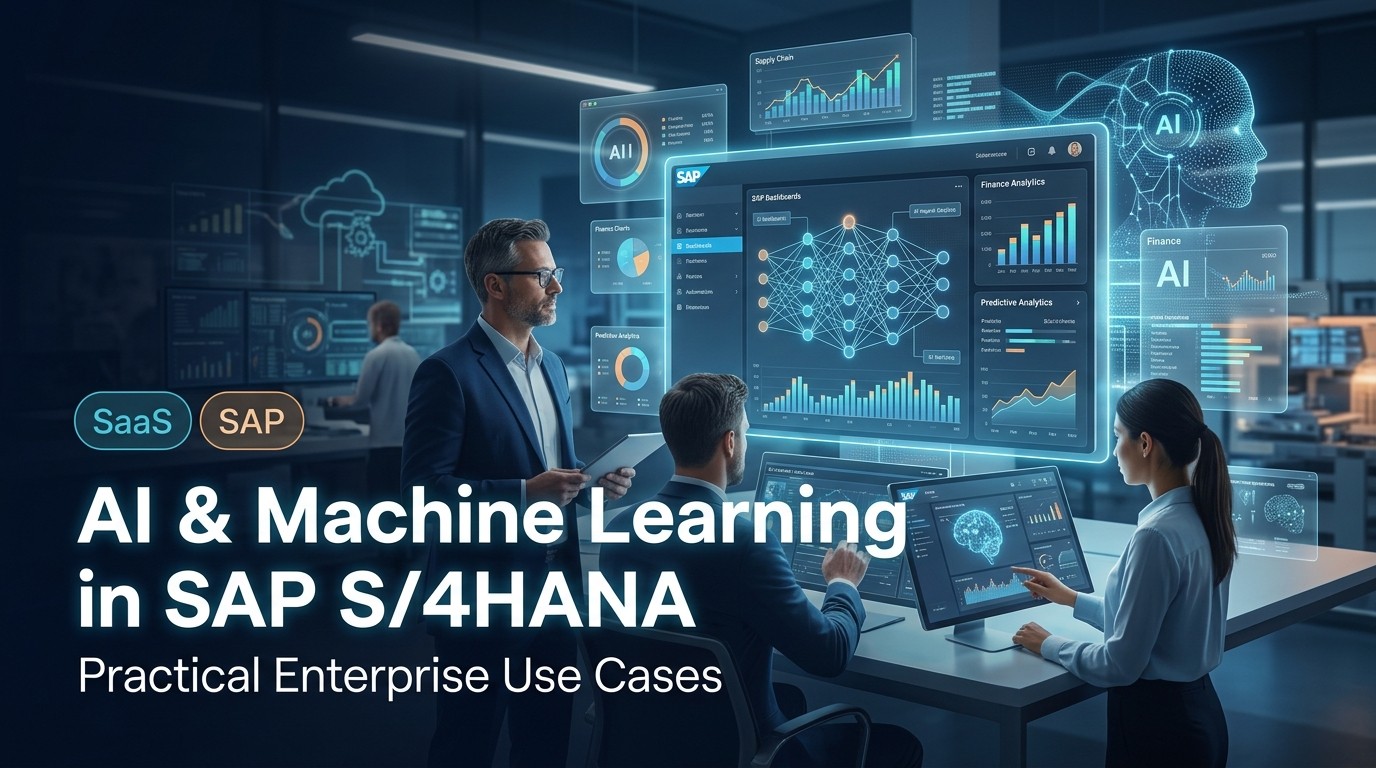
SAP S/4HANA changes that equation by combining real-time processing with embedded AI and machine learning capabilities. Instead of functioning purely as a transactional system, it becomes an operational intelligence platform capable of forecasting demand, detecting anomalies, automating workflows, and improving enterprise decision-making.
For innovation leaders, the opportunity is practical rather than theoretical: reduce operational friction while improving visibility across finance, procurement, supply chain, HR, and manufacturing.
Why AI in SAP S/4HANA Is Moving Beyond Hype
AI within SAP S/4HANA is gaining traction because enterprises already possess the one thing machine learning systems require most: operational data.
Purchase histories, inventory movement, vendor performance, employee records, production metrics, and financial transactions already exist inside ERP environments. SAP S/4HANA allows organizations to use that data more intelligently.
Unlike standalone AI tools that require complex integrations, SAP’s embedded AI capabilities operate closer to business workflows. That reduces latency, improves contextual decision-making, and limits the data silos that often weaken enterprise AI initiatives.
The result is not “AI for the sake of AI.” It is operational intelligence applied directly to enterprise processes.
What Makes SAP S/4HANA Suitable for AI and Machine Learning ?
Unified Enterprise Data and Real-Time Processing
Traditional ERP environments often struggle with fragmented systems and delayed analytics. SAP S/4HANA uses an in-memory architecture that processes large volumes of enterprise data in real time.
That matters because machine learning models rely on accurate, current information. Forecasting inventory demand using outdated procurement data produces unreliable outputs. Real-time visibility improves prediction quality and operational responsiveness.
For example, manufacturers can monitor production data continuously instead of waiting for end-of-day reports to identify inefficiencies or equipment issues.
Embedded Analytics and Intelligent Automation
SAP S/4HANA integrates analytics directly into operational workflows rather than separating reporting from execution.
This enables:
- Automated invoice matching
- Predictive maintenance alerts
- Demand forecasting
- Intelligent procurement recommendations
- Financial anomaly detection
The practical benefit is speed. Teams spend less time gathering data manually and more time acting on insights.
Practical AI Use Cases Across Enterprise Functions
Predictive Maintenance in Manufacturing
One of the most widely adopted AI use cases in SAP S/4HANA is predictive maintenance.
Instead of servicing equipment on fixed schedules, machine learning models analyze sensor data, maintenance history, and operational patterns to identify likely failures before breakdowns occur.
For manufacturers, this reduces:
- Unplanned downtime
- Emergency repair costs
- Production interruptions
- Spare inventory waste
A reactive maintenance model typically addresses problems after operations are already disrupted. Predictive maintenance shifts organizations toward proactive operations management.
AI-Powered Demand Forecasting in Supply Chain
Supply chain volatility has exposed the limitations of static forecasting models.
SAP S/4HANA uses AI-driven forecasting to analyze :
- Historical sales trends
- Seasonal demand fluctuations
- Supplier performance
- Market conditions
- Inventory movement
This improves procurement planning and inventory optimization.
For example, warehouse teams can avoid overstocking slow-moving products while maintaining sufficient stock for high-demand items. That balance directly impacts carrying costs and operational efficiency.
The inventory management challenges addressed here closely align with platforms like Dravya-O, which uses predictive analytics and intelligent reorder automation to improve stock visibility and procurement planning.
Intelligent Invoice Processing in Finance
Finance departments still spend considerable time managing repetitive validation and reconciliation tasks.
AI within SAP S/4HANA helps automate:
- Invoice data extraction
- Purchase order matching
- Duplicate invoice detection
- Payment validation
- Compliance checks
Machine learning models can also identify irregular spending patterns or potential fraud indicators faster than manual review processes.
This improves both accuracy and processing speed while reducing administrative overhead.
Smart Procurement and Vendor Risk Analysis
Procurement teams increasingly need visibility beyond pricing alone.
SAP AI tools can evaluate:
- Vendor reliability
- Delivery consistency
- Financial risk indicators
- Procurement cycle performance
- Supply chain disruption exposure
This enables more strategic sourcing decisions.
Organizations using intelligent vendor analysis can reduce procurement delays and strengthen supply chain resilience. It also supports better contract negotiations because vendor performance data becomes easier to quantify.
HR Automation and Workforce Analytics
HR teams are under pressure to manage larger workforces with leaner administrative capacity.
SAP S/4HANA supports AI-driven workforce analytics for:
- Recruitment screening
- Employee retention analysis
- Attendance pattern monitoring
- Payroll automation
- Performance tracking
Instead of relying entirely on manual reviews, HR leaders can identify workforce trends earlier and improve operational planning.
Sales Forecasting and Customer Intelligence
Sales forecasting remains difficult when CRM data is inconsistent or siloed across departments.
Machine learning within SAP environments improves visibility into:
- Customer buying behavior
- Revenue forecasting
- Lead scoring
- Sales cycle patterns
- Territory performance
That helps sales teams prioritize opportunities with higher conversion probability while improving operational forecasting accuracy.
Real Business Benefits Enterprises Are Seeing
The strongest AI use cases inside SAP S/4HANA share one characteristic: measurable operational impact.
Enterprises commonly report improvements in:
- Forecast accuracy
- Process automation
- Inventory optimization
- Financial visibility
- Operational response times
More importantly, AI reduces the volume of low-value manual tasks consuming operational teams.
That shift matters because ERP efficiency is no longer only about recordkeeping. Modern enterprises expect ERP platforms to support faster, data-informed decisions across departments.
Common Challenges Enterprises Face When Implementing AI in SAP
AI adoption inside ERP systems is rarely blocked by technology alone.
The larger obstacles are operational.
Poor Data Quality
Machine learning systems depend on structured, accurate enterprise data. Duplicate records, inconsistent reporting, and fragmented workflows weaken prediction accuracy.
Legacy Dependencies
Many organizations still operate hybrid ERP environments with aging integrations that complicate AI adoption.
Change Management Resistance
Operational teams often distrust automation when workflows change too quickly or without clear visibility into decision logic.
Governance and Compliance Concerns
AI systems handling financial, employee, or procurement data require strong governance frameworks and security controls.
Enterprises that ignore governance typically create larger operational risks later. Humans remain remarkably talented at turning useful systems into compliance disasters through neglect.
Why Enterprises Work with OASYS
Successful AI adoption requires more than software implementation. It requires operational alignment across workflows, integrations, data architecture, and security.
OASYS Tech Solutions Pvt. Ltd., a CMMI Level-5 and ISO 9001:2015 certified enterprise technology company, supports organizations through ERP modernization, AI/ML integration, workflow automation, and enterprise system optimization.
Its broader ecosystem reflects many of the operational priorities discussed in modern SAP environments:
- Dravya-O for intelligent inventory and warehouse management
- VIMS-O for vendor management and procurement workflows
- People-O for HR and workforce automation
- Sales-O for CRM analytics and field operations visibility0
The practical advantage is operational continuity. Businesses can integrate AI-driven workflows into existing enterprise processes instead of introducing disconnected tools that create additional complexity.
How Enterprises Should Prepare for AI-Driven SAP Transformation
Organizations approaching AI in SAP S/4HANA should avoid trying to automate everything simultaneously.
A more effective approach includes:
- Identifying high-impact operational bottlenecks
- Improving enterprise data quality
- Prioritizing measurable business outcomes
- Building governance frameworks early
- Expanding automation incrementally
The enterprises seeing the strongest results typically begin with focused use cases such as procurement automation, demand forecasting, or financial workflow optimization before scaling broader AI initiatives.
The Real Value of AI in SAP S/4HANA
The future of ERP is not about replacing human decision-making. It is about improving the speed, accuracy, and context behind operational decisions.
SAP S/4HANA becomes significantly more valuable when AI is embedded directly into enterprise workflows instead of treated as a disconnected experiment.
For innovation leaders, the goal should not be “using AI.” The goal should be building operational systems capable of responding faster, forecasting better, and reducing avoidable friction across the enterprise.
Because eventually every enterprise discovers the same uncomfortable truth: manual processes scale badly, spreadsheets age like milk, and operational inefficiency becomes expensive long before leadership notices it in quarterly reports.